
When the Hunter Became the Hunted
In nature, strength alone does not guarantee survival. Every predator, regardless of its power or reputation, lives by the same fundamental laws that govern all life—risk, resilience, and consequence. One of the most remarkable events ever documented at The Cretaceous Park serves as a powerful reminder that even the mightiest hunter is never beyond nature’s reach.
The incident occurred near the River Bank Observation Tower, where a mature Tyrannosaurus rex had established a large territorial range encompassing riverbanks, woodland edges, and open floodplains frequented by several herbivorous species. For weeks, our wildlife monitoring team had observed the predator tracking a nearby herd of Triceratops, patiently waiting for an opportunity to isolate a vulnerable individual.
On the morning of the encounter, guests and researchers witnessed the herd grazing peacefully along the riverbank. The towering herbivores remained vigilant, with adults positioned protectively around younger members of the group. Unknown to the herd, the Tyrannosaurus had been silently stalking them from the dense forest bordering the floodplain.
As the predator launched its ambush, the Triceratops reacted with remarkable speed and coordination. Rather than scattering in panic, the adults formed a defensive line, instinctively placing themselves between the predator and the younger animals. What followed was one of the most dramatic predator-prey confrontations ever observed within the sanctuary.
The Tyrannosaurus attempted to overpower one of the adult Triceratops, using its immense bite force and body mass to gain the advantage. However, the herbivore refused to retreat. In a sudden and forceful counterattack, the Triceratops lowered its massive head and drove one of its long facial horns deep into the predator’s lower abdomen.
The impact was devastating.
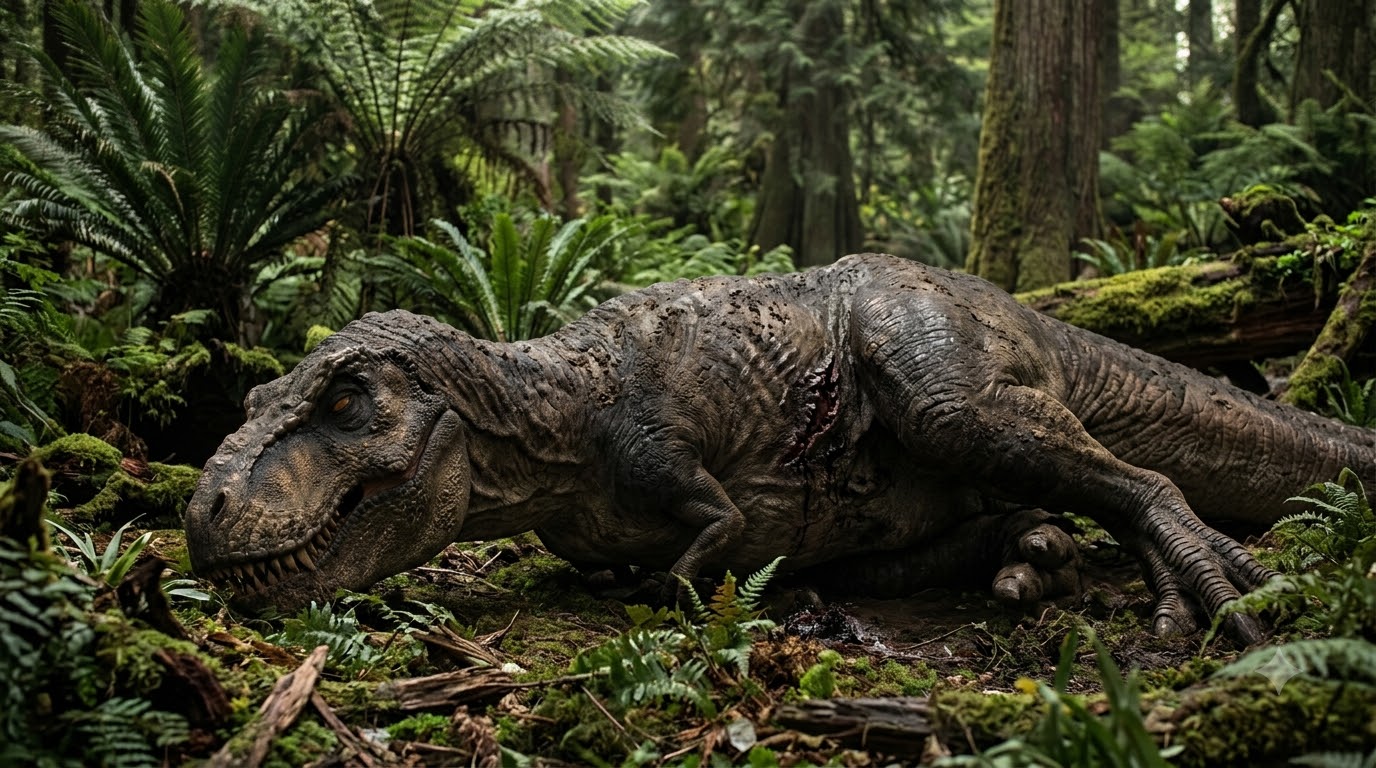
The Tyrannosaurus immediately broke off the attack and retreated toward the forest, leaving behind clear signs of severe trauma. Although the predator managed to escape, remote monitoring systems and veterinary teams continued to observe its condition from a safe distance to avoid interfering with the natural course of events.
Over the following days, the injury showed signs of progressive deterioration. Despite the animal’s resilience, the deep puncture wound became infected. Its movements gradually slowed, hunting activity declined, and the once-dominant predator became increasingly weakened. Unable to successfully capture sufficient prey and suffering from complications associated with the infected wound, the Tyrannosaurus eventually succumbed to its injuries.
For many visitors, the outcome was unexpected. The Tyrannosaurus rex is widely regarded as the ultimate predator of the Late Cretaceous, yet this event demonstrated a fundamental truth of natural ecosystems: prey species are not defenseless. Large herbivores evolved powerful anatomical and behavioural adaptations specifically to survive encounters with predators, and when forced to defend themselves, they can inflict life-threatening injuries.
The incident also highlighted the extraordinary social behaviour of Triceratops. Rather than abandoning vulnerable members of the herd, the adults responded collectively, using their size, horns, and coordinated movements to repel the attack. Such defensive behaviour plays a vital role in the survival of herd-living animals and contributes to the balance between predators and prey within the sanctuary.
From a scientific perspective, this event offered invaluable insight into predator-prey dynamics within a restored prehistoric ecosystem. It reaffirmed that apex predators face significant risks during every hunt and that even a successful attack can come at a considerable cost. Every confrontation requires enormous energy, precise timing, and exposes both hunter and hunted to serious injury.
At The Cretaceous Park, our philosophy is to observe rather than interfere in natural ecological interactions whenever it is safe and ethically appropriate to do so. While our veterinary teams continuously monitor the health of all animals, natural predation, competition, and the challenges of survival remain essential components of a functioning ecosystem. Intervening in such encounters would compromise the ecological authenticity that defines the sanctuary.
The loss of this magnificent Tyrannosaurus was a sobering moment for our researchers, staff, and guests. Yet it also served as a profound lesson in the balance of nature. Predators shape ecosystems by regulating herbivore populations, while herbivores evolve powerful defenses that challenge even the most formidable hunters. Together, these relationships create the dynamic equilibrium that has sustained life for millions of years.
The events witnessed at the River Bank Observation Tower remind us that nature does not recognize titles such as “king” or “invincible.” Survival belongs not simply to the strongest, but to those capable of adapting, enduring, and overcoming the countless challenges of the wild.
Sometimes, in the timeless struggle between predator and prey, even the hunter can become the hunted.